.webp)
Migration & delivery
Jira Product Discovery: Clearer Priorities
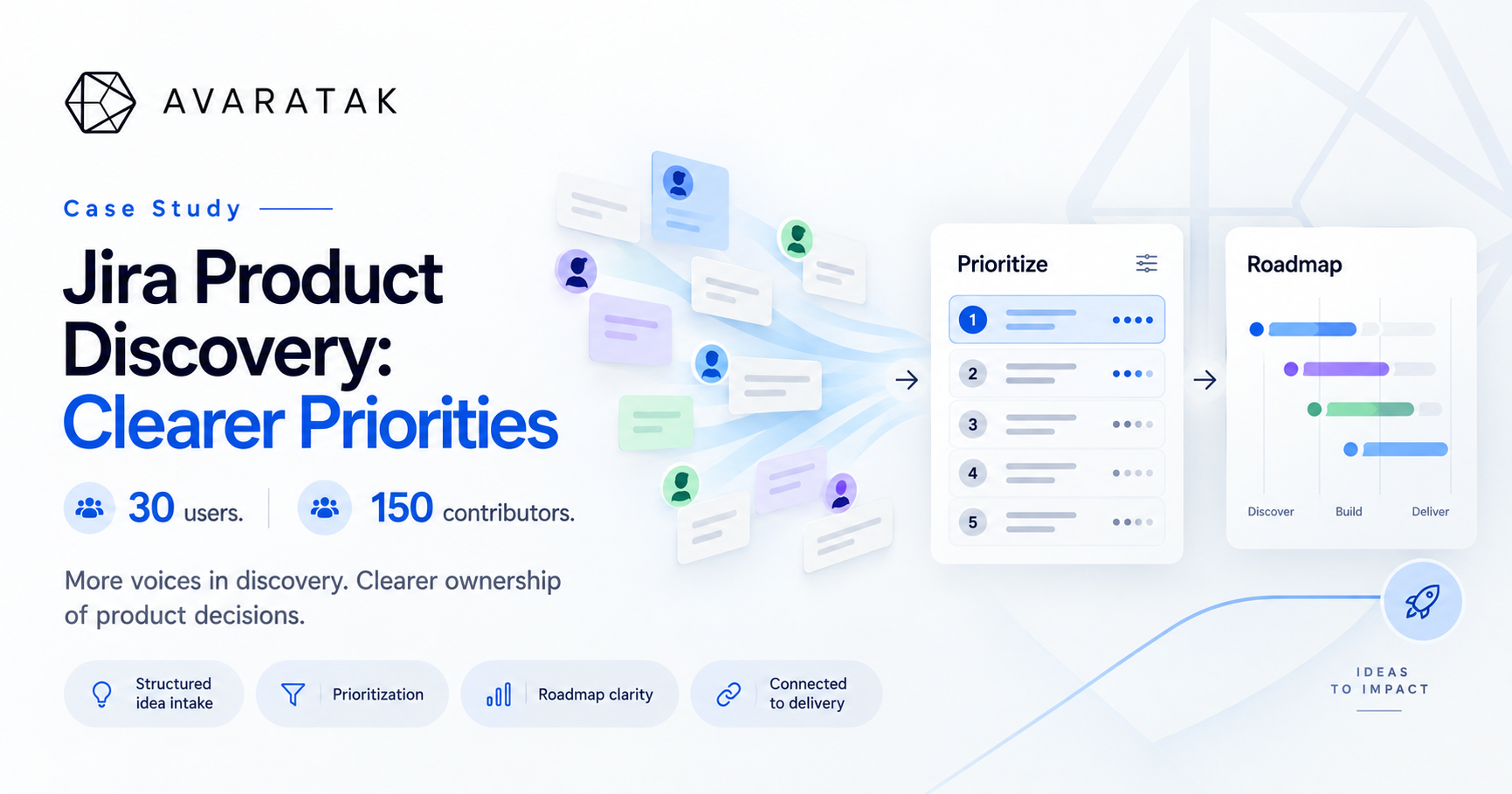
30 users. 150 contributors. More voices in discovery. Clearer ownership of product decisions.

01
The challenge
Product discovery should bring the business closer to product decisions, not create another backlog nobody understands. With 30 users and 150 contributors, this organization worked with Avaratak to turn broad business input into a clearer, more accountable product planning process.
Collecting ideas is only the beginning
The challenge was not a shortage of ideas. It was the need for a consistent way to understand them, compare their value and explain what would happen next. An idea needed more than a title. Reviewers needed to understand the problem, the people affected and the evidence behind the request.
That creates an important distinction: giving people a way to contribute does not mean giving every request a place on the delivery roadmap. The process needed to welcome useful input while making the responsibility for prioritization unmistakable.
For a discovery environment of this scale, the central questions were practical. Who reviews new ideas? What makes an opportunity ready for evaluation? Who can commit delivery capacity? How does a contributor learn that an idea is being explored, deferred or taken forward?
The Avaratak consulting approach addressed those decisions before configuring the tool. The objective was broader participation without turning prioritization into a popularity contest.
02
Our approach
Design the decision process before configuring the tool. Avaratak started with responsibilities, evaluation criteria and communication expectations. Jira Product Discovery made those agreements easier to follow rather than replacing them.
Participation and decision-making are different jobs
The 30-user and 150-contributor environment needed to support participation without making every participant responsible for administration or roadmap decisions. Atlassian distinguishes creators and contributors. Contributors can add comments, insights and votes, and can submit ideas when that permission is enabled. The design principle was to give each audience the access its responsibilities required.
The evaluation model began with a small set of shared questions: what problem are we solving, who benefits, what evidence supports it and what trade-off would pursuing it require? The criteria needed to be understandable enough that people could explain a decision without explaining the scoring formula first.
Make contributing easy. Make evaluation consistent. Make ownership explicit.
A roadmap is not a promise to build every idea
Exploration, prioritization and commitment have different meanings. An opportunity can be worth investigating without being ready for delivery. The model made that distinction visible, alongside an owner and a clear next step.
The same thinking carried through to enablement: contributors needed to understand what makes input useful, reviewers needed consistent evaluation practices, and decision-makers needed to know how to communicate the rationale. For more on the tool's role, read Between the Sticky Note and the Sprint: Where Jira Product Discovery Earns Its Keep.
03
What we built
Avaratak brought six connected elements into the discovery process, keeping participation, evidence, prioritization and delivery connected.
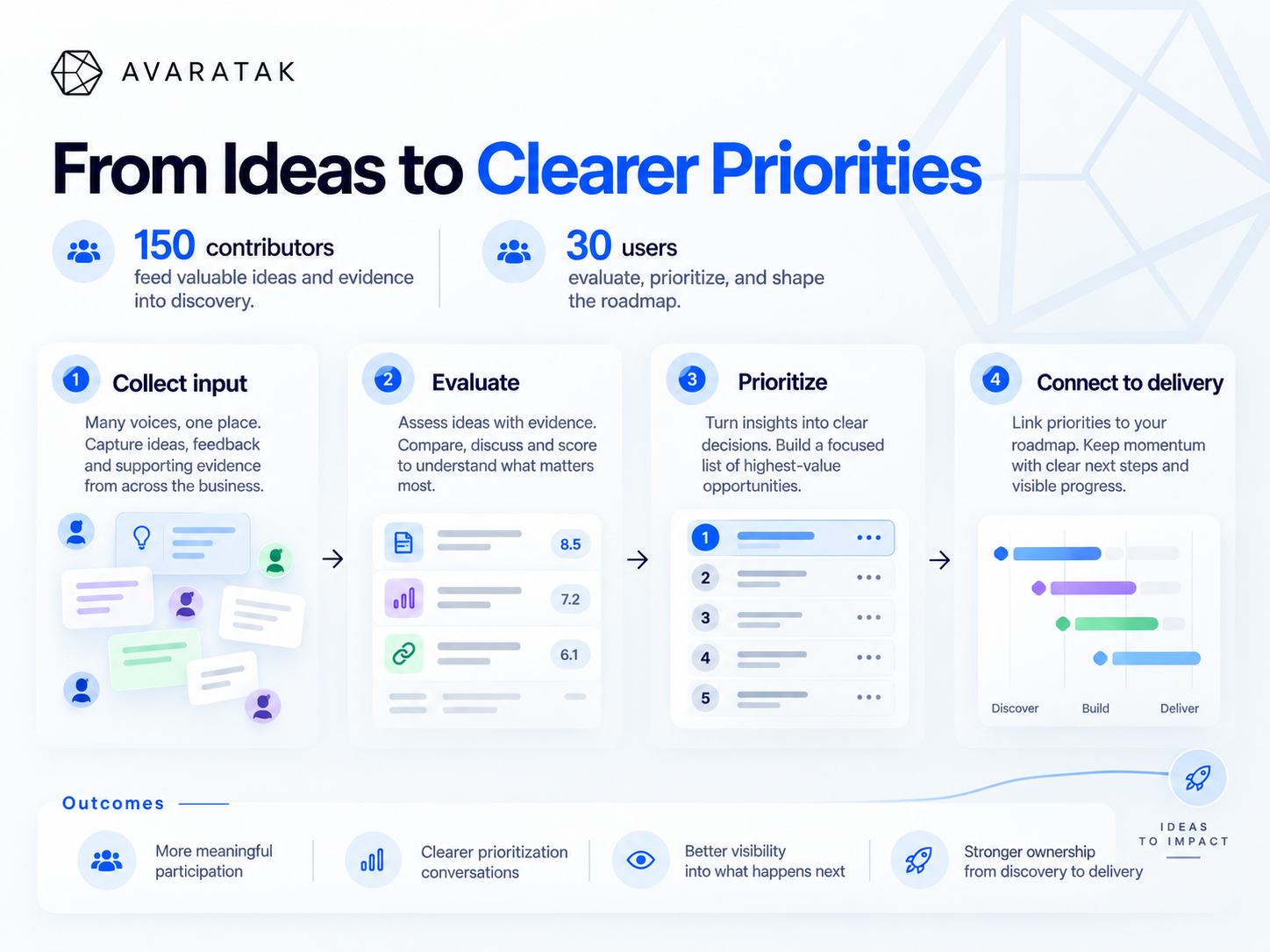
- Structured idea intake A consistent starting point covering the problem, affected audience, expected benefit and supporting context. The initial submission stayed straightforward, with deeper analysis added as an opportunity progressed.
- Evidence alongside the idea Relevant observations and feedback kept with the opportunity they informed. Jira Product Discovery insights helped preserve the context behind a request rather than just its title.
- Clear responsibility for decisions Defined ownership of intake, clarification, evaluation and roadmap decisions. Broad participation expanded the information available without obscuring who was accountable for the choice.
- Prioritization people can explain Shared criteria and recorded rationale for comparing opportunities. Jira Product Discovery's custom fields support criteria such as impact and effort. The score informed the conversation; it did not replace judgment.
- Roadmaps with understandable boundaries Views designed to communicate direction and status, with a deliberate distinction between ideas being explored and work that had been committed. Stakeholders did not need to interpret internal shorthand to understand the plan.
- A connection to delivery Ideas linked to Jira delivery work, preserving the reason for the work as it moved toward implementation rather than leaving its business context behind.
04
The results
The organization gained a more understandable path from business input to product decisions and delivery.
- More meaningful participation Contributors gained a clearer route to bring ideas and supporting context into product planning. Their input became part of the decision process rather than simply another request in a queue.
- Clearer prioritization conversations The team gained a shared basis for comparing opportunities and explaining trade-offs. Discussions could focus on agreed criteria and supporting evidence rather than the persistence of the person making the request.
- Better visibility into what happens next Stakeholders could distinguish an idea under consideration, an opportunity being explored and work moving toward delivery. The roadmap communicated both the direction and the reasoning behind it.
- Stronger ownership without closing the door to input The discovery process welcomed a substantial contributor community while keeping responsibility for evaluation and roadmap decisions clear. Broad participation and disciplined decisions reinforced each other.
The Avaratak take
An effective discovery process does not promise that every idea will be delivered. It gives ideas a fair route into consideration, supports consistent evaluation and makes the resulting decision understandable.
The goal is not a bigger backlog. It is a better basis for deciding what deserves to be built.
Looking at your own discovery process? Start with one difficult product decision: can the team show the problem, the evidence, the owner and the reason for the choice? Bring it to a 30-minute product discovery conversation.
05
In their words
“We have a place to bring customer feedback into the discussion and a clear way to see what happens next. The roadmap is no longer just a list of requests; we can understand the reasoning behind it.”
VP of IT
“More people can contribute without leaving everyone responsible for the final decision. We can see the evidence, discuss the trade-offs and keep ownership clear.”
CTO
More voices, clearer priorities
Build a roadmap people understand
Bring us the prioritization decision your team keeps revisiting. Avaratak's Senior-only Atlassian consultants will help you assess the process, clarify ownership and determine where Jira Product Discovery fits.